Sunday, 29 April 2012

77 Schriftsteller

„2005 begann ich damit, Schriftsteller am Ende eines Interviews darum zu bitten, für einen Augenblick zu ihrem eigenen Gesprächspartner zu werden. Sie sollten sich selbst eine Frage stellen und sie dann auch beantworten, in der jeweiligen Muttersprache und vor dem Mikrofon“, schreibt Herausgeber Tobias Wenzel im Vorwort. Gute Idee, dachte ich, bevor ich das Buch zur Hand nahm. Jetzt im Nachhinein bin ich mir da gar nicht mehr so sicher. Das liegt zum einen daran, dass ich mit vielen Fragen und Antworten nicht viel bis gar nichts anfangen konnte, und zum andern, dass ich den Eindruck hatte, man hätte dieses Experiment auch mit irgendwelchen Leuten von der Strasse machen können, es wäre wohl in etwa auf dasselbe heraus gekommen oder anders gesagt: Schriftsteller stellen sich offenbar nicht schlauere oder interessantere Fragen und geben sich auch nicht viel schlauere oder interessantere Antworten als andere auch. Sicher, es gibt Ausnahmen. Ein paar will ich hier erwähnen:

Gao Xingjian, was haben Sie noch nicht gemacht, würden Sie aber gerne einmal machen? Musik. Ich habe einen Rhythmus in mir. Aber er ist sehr schwer umzusetzen.

Richard Ford, weisst du, was wichtig für dich ist? Nein, aber ich lege mir etwas zurecht.

Herr Enzensberger, warum sind sie nicht unglücklich? Die Zeit, die mir bleibt, ist mir dafür zu schade.

Liza (Marklund), hat das Leben einen Sinn? Eigentlich nicht. Das wissen wir ja. Und mit diesem Wissen kann man nicht leben. Deshalb haben wir die Drogen erfunden, die Religion und den Terrorismus. Aber es gibt eine Sache, die wir durchaus tun können: Ich glaube, dass wir unsere Gesellschaft, die Welt verändern können. Wenn also das Leben nun mal einen Sinn haben muss, dann sollten wir genau das tun. Das kommt anderen Menschen zugute.

Was diesen Band speziell macht, sind die eindrücklichen Fotos von Carolin Seeliger. Jonathan Franzen äussert sich zum Posieren für die Kamera so: „So paradox das auch klingen mag: Man kann sein Privatleben schützen, indem man sich selbst der Kamera aussetzt und lächelt. Wenn man ja sagt, hat man Kontrolle über eine Sache, über die man vielleicht keine Kontrolle hat, wenn man nein sagt. Je mehr man von sich preisgibt, desto geschützter ist man. Ich habe keine Ahnung, wie das funktioniert. Aber so empfinde ich es.“ Übrigens: auf dem Porträt von Franzen, das neben diesem Text abgebildet ist, lächelt er nicht.

PS: Nicht erschlossen hat sich mir, weshalb die Befragten sich in der jeweiligen Muttersprache und vor dem Mikrofon äussern sollten – im vorliegenden Buch finden sich ihre Fragen und Antworten ins Deutsche übertragen.

Tobias Wenzel / Carolin Seeliger
Was ich mich schon immer fragen wollte
77 Schriftsteller im Selbstgespräch
Benteli Verlag, Bern und Sulgen 2008

Sunday, 22 April 2012

Pulitzer Prize 2012

When, a few days ago, it was announced that Massoud Hossaini got the Pulitzer-Prize in the category Breaking News Photography, I clicked through the sequence of photographs that were displayed on the website of the Süddeutsche Zeitung.

The second photo in the series, the one for which Massoud Hossaini received the Pulitzer, showed Tarana Akbari, 12, amidst dead bodies, screaming in fear moments after a suicide bomber detonated a bomb in a crowd at the Abul Fazel Shrine in Kabul on 6 December 2011.

Copyright @ Massoud Hossaini

The next photo showed the photographer upon learning that he had won the Pulitzer.

Copyright @ AFP

The next couple of days, on various internet sites, I again and again came across the picture of the screaming girl in green – and always the pic of the happy photographer came to mind, although I had seen the photo of him only once.

It goes without saying that looking at a photograph in a series is very different from looking at a photograph that stands alone. To present a series of photographs requires thinking. What pic should I put first? What pic should follow? Should the pics relate to each other? Should there be an order or should the viewer be left alone and do with the pics what he deems fit?

I do not know what the picture editor of the Süddeutsche Zeitung had in mind when he placed the photograph of the happy photographer next to the one of the screaming Tarana Akbari, but probably not much. In any case, the effect this, in my view, totally insensitive positioning had on me was devastating. It made me once again aware that to shoot disturbing and necessary pictures is a career, a business, a way to make a living. Maybe the picture editor of the Süddeutsche Zeitung wanted to show us precisely that. If so, he should also receive an award.

Sunday, 15 April 2012

Cedric Nunn

Since the end of the 1970s, Cedric Nunn's photographic work has focused on people from his homeland, South Africa, I read in the preface by Ralf-P. Seippel - and briefly wondered what the P. might stand for. Anyway, having worked as an ICRC-delegate in KwaZulu-Natal in 1994/1995, this tome aroused my special interest.

"In photography", writes Cedric Nunn, " I saw a medium that would allow me to express myself in relation to various issues that I was becoming aware of. The most obvious was the extent of the racial division and exploitation to which we blacks were subjected. I was particularly struck by the racism in my own mixed-race community and sought to understand this and why it was that mixed-race people were so prone to alcoholism, unemployment, broken marriages, teenage pregnancy, and other social ills. Very quickly I learned that these issues had a national character and that the remedy for them was indeed a national one. I remember a discussion with my father in which I vented my frustration at the state of the nation. His quiet response was: 'Do something about it.' These photographs, which span a thirty-year journey in photography, are in a sense my answer to that challenge."

Copyright @ Hatje Cantz, 2012

Although I think many of the photographs in this tome excellent, I fail to see how they could possibly give answers to questions "on alcoholism, unemployment, broken marriages, teenage pregnancy, and other social ills." So what do Nunn's photographs then do? In my view, they illustrate carefully chosen aspects of life in Southern Africa, they show me a wide variety of often impressive scenes that document a social reality that we need to confront in order to change it. Lewis Hine came to mind, who "sought to apply to documentary photography: 'to show things that had to be corrected' as well as 'things to be appreciated'", as Andries Walter Oliphant points out in his essay "Writing with Light: Textures of Life in the Early Photography of Cedric Nunn".

Copyright @ Hatje Cantz, 2012

"... what made you feel confident that photography was your metier?", asks Okwui Enwezor, and Nunn replies: "It was the incredible powerful feeling I had, it certainly wasn't any intellectual sense that I could master this medium (...) the medium called me, and I was on a journey to produce images that people like Omar Badsha and David Goldblatt were producing. Later I met Santu Mofokeng, Guy Tillim, and others. I was in awe of them and wanted the kind of ability that they have."

I thought the captions that accompany Nunn's photographs often irritating: A young boy playing, the caption reads: "community forcibly removed to make way for a game reserve." Or: A guy holding a guitar, the caption reads: "Migrant worker from the Eastern Cape on a sugar farm."

Copyright @ Hatje Cantz, 2012

The caption of the pic above reads: "Children from Arniston or Waenhuiskrans surfing off the Western Cape coast. Frequent missile testing at a nearby military base prevented fishermen from their village going out on boats to earn a living." This photo and caption illustrate (although I doubt that this was intended) what the problem with social documentary is: the picture cannot show what it is supposed to show; we need to bring to the picture what is not there in order to see what the photographer wanted to show us.

Cedric Nunn
Call and Response
Hatje Cantz, Ostfildern 2012

Sunday, 8 April 2012

On Learning Language

I have put my faith in language - hence the panic when a simple word illudes me, when I stare at a piece of flowered material in front of a window and do not know what name to give it. Curtain. Thank God. I control the world so long as I can name it. Which is why children must chase language before they do anything else, tame the wilderness by describing it, challenge God by learning His hundred names. 'What's that called?' Lisa used to ask me. 'And that? And that?'

Penelope Lively: Moon Tiger

Sunday, 1 April 2012

Insular Insight

First things first: Insular Insight is a superbly done book; it is a joy to touch, to hold, to look at, leaf through, and spend time with.

What is it about?
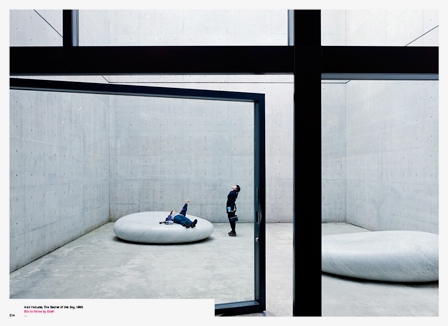
It is about islands and ideas. For two decades, Soichiro Fukutake has created - on Naoshima and the islands of the Seto Inland Sea - "a place where local action harmonizes with global thinking", I read in the foreword. Moreover: "Insular Insight seeks to inspire reflection about the potential to create places in harmony with the natural environment - where the conditions that ensure 'well-being' are considered and debated, where social systems are called into question, where alternatives can be creatively explored, and, most importantly, where new ways of life can be discovered." Since, recently, such thoughts have been very much on my mind, I've approached this tome with quite some curiosity.

Insular Insight is a book about art and architecture on the archipelago of the Setouchi islands in the Seto Inland Sea in the southwest of Japan. Why would somebody think of bringing contemporary art to islands? "I began to feel the need for a "civilization of maintenance and development,' one that 'uses what exists to create what is to be.'" writes Soichiro Fukutake. And he was convinced that "it would be possible to effect change by placing art that takes a healthy, critical view of contemporary society in original Japanese landscapes untainted by modernization."

So what does that mean in practice? Let me give you the example of Tatsuo Miyajima, who "came to prominence in the late 1980s with monumental installations" and whose project for Naoshima was to install contemporary artwork in an old Japanese house with the help of local residents who had little experience with contemporary art. In the process, Miyajima made a great discovery: "Rather than learning to understand the obscurities of contemporary art, people discover their own artistic potential through active participation." I thought it especially touching that many of the people who helped belonged to the elderly.

There are many wonderful photographs (by Iwan Baan) found in this book as well as lots of information about the various projects on the Seto Inland Sea. Unfortunately, Insular Insight contains also learned essays that have very little (or nothing) to do with Naoshima, Teshima or Inujima but do quote Shakespeare, the old Greeks or refer to the Judeo-Christian concept of the Garden of Eden – I could have done without them.

Anyway, I feel like ending this review on a positive note for I've very much enjoyed spending time with this tome: on the very last pages there are exquisite Gelatin-silver prints by Hiroshi Sugimoto, accompanied by these inspiring words: "Occupying a space that is intended for the repose of the soul."

Insular Insight
Where Art and Architecture Conspire with Nature
Lars Müller Publishers, Baden 2011

Sunday, 25 March 2012

Schweizerhochdeutsch

Anzuzeigen ist ein ungemein anregendes Werk: Schweizerhochdeutsch, das Wörterbuch der Standardsprache in der deutschen Schweiz. Darin findet sich viel Lehrreiches, Erhellendes und Staunenswertes. Ich jedenfalls habe nicht schlecht gestaunt, dass es sich bei 'allfällig' um Schweizerhochdeutsch handelt und im Hochdeutschen 'etwaig, allenfalls vorkommend' heisst. Auch 'drinliegen' habe ich bislang für ein hochdeutsches Verb gehalten ... und und und, dieser Duden ist voll davon.

'Klassenzusammenkunft' heisst auf Hochdeutsch 'Klassentreffen', die 'Klus' ist ein 'enger Taldurchbruch durch eine Gebirgskette' und eine 'Kartonschachtel' ein 'aus Karton hergestellter Behälter' oder eine 'Kartonage'.

Nicht bewusst war mir, wie zahlreich die Wörter sind, für die mir nicht auf Anhieb ein hochdeutsches Wort einfällt. Etwa für 'abtischen', 'einkassieren' oder 'Egli'.

Und was sind bloss 'Laubflecken'? Offenbar ist das Schweizerhochdeutsch für 'Sommersprossen'. Und was ist ein 'Nauen'? Das ist ebenfalls Schweizerhochdeutsch und meint ein 'grosses, flaches Lastschiff'.

Und dann die Erläuterungen: Etwa, dass es sich bei der 'Kalbsbratwurst' um eine 'ungeräucherte Wurst mit einem Anteil von mindestens 50% Kalbfleisch' und dass es sich bei einem 'Kantonnement' um eine 'Unterkunft für militärische Truppen' handelt.

Einigermassen verblüfft war ich auch darüber, dass es nicht wenige schweizerische Ausdrücke gibt, die mir zwar geläufig sind, die ich aber gar nicht verstehe. 'Niveauübergang' zum Beispiel. Es ist, so lese ich, ein 'Bahnübergang, bei dem die Gleise überfahren bezw. überschritten werden (ohne Brücke oder Unterführung)' ...?!

PS: Hugo Loetscher hat einmal sehr amüsant von seinen Schwierigkeiten mit seinem deutschen Lektor berichtet und dabei darauf hingewiesen, dass es im Hochdeutschen keine treffende Übertragung für das schweizerische 'Übergwändli' gibt. Das gilt trotz dieses in jeder Hinsicht zu empfehlenden Werkes nach wie vor.

Fazit: wunderbar informativ und sehr unterhaltsam, eine wahre Schatztruhe.

DUDEN
Schweizerhochdeutsch
Wörterbuch der Standardsprache in der deutschen Schweiz
Dudenverlag, Mannheim - Zürich 2012

Sunday, 18 March 2012

Future Science


As "cutting-edge essays from the new generation of scientists" advertises Oxford University Press this collection from neuroscience and evolutionary psychology to plant populations and oceanography.

"I would have killed for books like this when I was a student", Brian Eno is quoted on the cover. Well, I wouldn't have. Nevertheless, I do find Future Science an inspiring work. Mainly, because I've learned stuff that was completely new to me.

Here are some examples:
"Despite considerable evidence to the contrary, Earth was not a particularly good place for life to arise. The main ingredients for life as we know it are a lot easier to find farther out in the Solar System." (Kevin P. Hand: On the Coming Age of Ocean Exploration).

"Children are intention readers, not just behavior copiers (...) Altruistic behaviors do not appear to be solely the outcome of cultural norms and socialization. No doubt socialization practices profoundly influence children's development and cultural norms can facilitate and sustain whatever is jump-started by biological inheritance. Despite altruism's early emergence, children have a lot to learn about how and whom to help. For example, we should not blindly help everyone (such as those with bad intentions); it is essential that we learn when to help and when not to help." (Felix Warneken: Children's Helping Hands).

"Science has recently called into question the old adage that beauty is in the eye of the beholder. What makes a person attractive may not be solely a matter of individual taste or a particular culture but instead may reflect evolved preferences - predilections handed down from our prehistoric ancestors. Isolated and evolutionary relevant groups such as hunter-gatherers may hold the key to important questions underlying the origins of attractiveness." (Coren Apicella: On the Universality of Attractiveness).

"Piaget's great gift was to find cases in which children make judgements that are strikingly different from those of adults, and his study of moral judgement is no exception (...) Young children tend to focus on causal responsibility, while older children and adults tend to focus on intent." (Fiery Cushman: Should the Law Depend on Luck?)

The Economist rightly remarked that "the essays are of uneven quality. A few of the contributors seem to be born writers, but a couple seem happier to stick with the jargon and densely packed prose that plagues most papers in scientific journals."

Still, Future Science is a fascinating read, although I'm not sure whether, say, evolutionary psychology, is really a science and not just a theory.

Future Science
Essays from the Cutting Edge
Edited and with a preface by Max Brockman
Oxford University Press, 2011