Wednesday, 25 December 2013
Wednesday, 18 December 2013
Swiss Autumn Colours
These pics were taken on 26 October 2013 on the way from Landquart via Malans and Jenins to Maienfeld. I do not think them remarkable as photographs, what intrigues me about them is what they show, and especially their colours.
We all know that photography is about framing, about selecting the right angle, and, probably above all, about the light. What amazes me about the light that my camera created is how different the colours are, and also, how quickly the light had changed for although I was walking for about two to three hours, the pics displayed were taken, roughly, in the course of maybe half an hour.
Needless to say, I do know that from one second to the next everything can change, and that does indeed include the light. Yet knowing is one thing, to be shown quite another. As Barry Lopez once phrased it: "I realized that just as the distance between what I saw and what I was able to record was huge, so was that between what I recorded and what people saw."
It does not cease to baffle me how the mind works: on my walk, all of a sudden a church (or was it a convent or maybe a chapel?) surrounded by trees came to mind, not a Swiss church though but one on the outskirts of Santa Cruz do Sul, a town in the Brazilian state of Rio Grande do Sul. I was astonished but did not feel like exploring the why, did not want to look for acceptable logic. Instead, I let the wondering pass and enjoyed what came next and then went again.
Wednesday, 11 December 2013
Los Angeles / New York
I've written about these two books before on this blog yet the ones I'm referring to now are previously unpublished editions, they come in a smaller format and belong to Taschen's Piccolo-series of which the publisher says: "192 pages distilling the best of the originals into pocket-sized books that won't put a dent in you wallet."
Going through these two small books I felt once again fascinated by the variety of photographs shown, the earliest from the 19th century. This is to say that spending time with these two handy volumes also means going back to see how things once looked ... and do not look anymore ...
Jim Heimann
Los Angeles. Portrait of a City
Flexicover, 11,9 x 16,6 cm, 192 pages, 7,99 Euro
Reuel Golden
New York. Portrait of a City
Flexicover, 11,9 x 16,6 cm, 192 pages, 7,99 Euro
Taschen, Cologne 2013
Wednesday, 4 December 2013
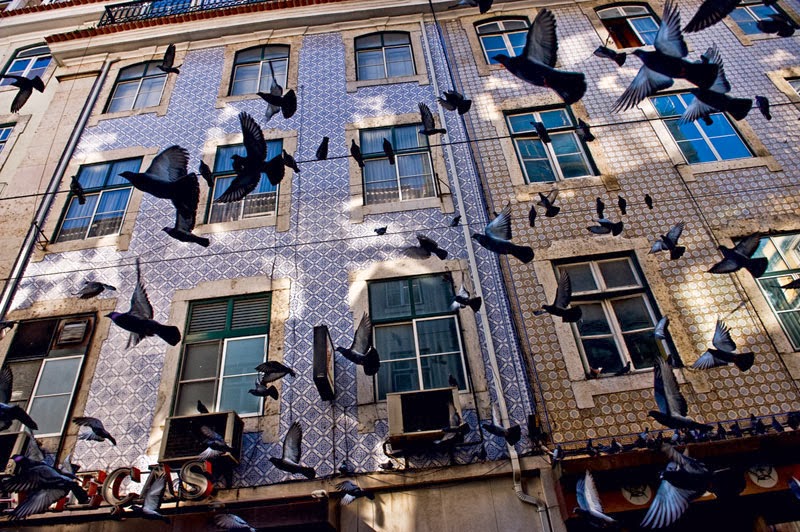
Jan Windszus: Lissabon
"Jan Windszus' Bilder beeindrucken ... vor allem durch Sinnlichkeit. Man erkennt nicht in erster Linie, sondern empfindet", schreibt Nikolaus Gelpke im Vorwort. Das trifft es genau, jedenfalls war das auch meine Empfindung, obwohl, möchte man sogleich fragend hinzufügen: Ist das beim Betrachten von Fotografien nicht immer so? Kommt zuerst nicht immer die Empfindung? Sicher, doch eben nicht so direkt und sinnlich und intensiv wie bei diesen Lissabon-Bildern von Jan Windszus.
Copyright @ Jan Windszus 2013
Es hat seinen ganz besonderen Reiz, Bilder von einer Stadt zu betrachten, die man aus eigener Anschauung kennt, sich Szenen zeigen lassen, die man so nie gesehen hat und die einem doch eigenartig vertraut vorkommen, jedenfalls einige davon. Obwohl: sinnlich habe ich die Stadt nicht in Erinnerung, doch sinnlich wird sie mir hier gezeigt. Und genau deshalb spricht mich dieses Buch an: weil es mir ein Lissabon zeigt, das ich so nicht kenne. Und von dem ich mir vorstelle, dass ich es beim nächsten Besuch so suchen werde.
Copyright @ Jan Windszus 2013
Während ich Jan Windszus' Fotografien, die auf mich wie gemalt, ja wie Edward Hopper-Gemälde wirken, betrachte, läuft in meinem Kopf ein Film ab. Ich frage mich, was wohl als nächstes kommt, was die Folgebilder mir zeigen würden/könnten. Anders gesagt: ich nehme viele Aufnahmen in diesem Band als Standbilder eines Films war. Vermutlich, weil ich sie als gestellt, als unwirklich empfinde. Und als Sehnsucht ausstrahlend.
Copyright @ Jan Windszus 2013
Ich stelle mir vor, dass Jan Windszus Bilder einer melancholischen Stadt im Kopf hatte, als er diese Aufnahmen machte. Denn schliesslich sieht man, was man sich entschieden hat zu sehen, was man sehen will. Und wir, die Betrachter, kriegen zu sehen, was Fotograf und Verlag beschlossen haben, uns vorzulegen. Ich habe mich gerne auf diese fotografierten Stimmungen eingelassen.
PS: Neben dem bereits erwähnten Vorwort des Herausgebers Nikolaus Gelpke ist diesem schön gemachten Band auch ein gut geschriebener und kenntnisreicher Text von Karl Spurzem beigegeben, der allerdings keinerlei Bezug auf Jan Windszus' Fotografien nimmt.
Jan Windszus
Lissabon
Mare Verlag, Hamburg 2013
Wednesday, 27 November 2013
Writing on the Wall
Writing on the Wall is a good read: well-written, entertaining, and informative. The point that the author is making could be summed up in this quote by Robin Dunbar: "Without gossip, there would be no society."
Mass media are a relatively recent phenomenon and only about 150 years old. Before that we had, as Tom Standage argues, social-media ecosystems. The first of them were the Roman media. "... the fortunes of Rome's vast territories depended to an inordinate extent on the personal ties between members of the Roman elite. Social gossip and political news were intertwined." Information was exchanged in person or by letters. There were also books but "no publishers, no copyright, and very few booksellers. Instead, books circulated from one reader to the next through recommendation and copying." During the Reformation, there were pamphlets, news ballads, and woodcuts. Later on, at the Tudor court, it was poetry that was used to communicate. "The circulation of poems in manuscript form provided a gossipy back channel behind the outward formality and strict rules of court life, and a conveniently ambiguous way to make political points." And then there were manuscript copies of speeches and parliamentary reports that circulated widely. And, again quite some years later, there were the coffeehouses, and ... in short: humans are wired for sharing and they do so with the means at their disposal.
When printing was invented and began to dominate the exchange of information, the agenda-setting became concentrated in the hands of a few. Eventually, the owners of radio and television took over and thus acquired a factual monopoly on the spread of news. This monopoly is now being broken up again by the internet. So back to the roots then? Not really for the exchange of social information in modern societies is hardly comparable to the one of ancient times. Nowadays, "various forms of media make possible gossip at a distance", to be physically present is not required anymore.
In Tom Standage's view, television has become "the most pervasive medium ever. The couch potato, vegetating in front of the flickering screen, emerged as a cultural cliché. Watching television, an entirely one-way, passive experience, became the very definition of inaction. Only sleeping involves less effort. The broadcast model considers the role of the radio listener and television viewer to be merely that of a passive consumer. This is as far as it is possible from a media system in which people create, distribute, share, and rework information and exchange it with each other. It is the opposite of social media."
Writing on the Wall provides a helpful perspective in regards to the role that social media play in triggering protests and revolutions. "Historically, it is clear that social media, in the form of pamphlets, letters, and local newspapers, played a role in the Reformation, and in the American and French Revolution. But it is also clear, from a distance, that its main function was to reveal and synchronize public opinion and expose the extent of the opposition to the incumbent regime. In each case, simmering resentments meant that revolution would have happened sooner or later anyway; the use of social media merely helped the process along." Agreed, yet this description of the impact of social media could equally be used to describe the role of mass media that produce often not more than loud noise that accompanies events that would also have taken place without them.
Tom Standage
Writing on the Wall
Social Media - The First 2,000 Years
Bloomsbury Publishing, London, New Delhi, New York and Sydney
Mass media are a relatively recent phenomenon and only about 150 years old. Before that we had, as Tom Standage argues, social-media ecosystems. The first of them were the Roman media. "... the fortunes of Rome's vast territories depended to an inordinate extent on the personal ties between members of the Roman elite. Social gossip and political news were intertwined." Information was exchanged in person or by letters. There were also books but "no publishers, no copyright, and very few booksellers. Instead, books circulated from one reader to the next through recommendation and copying." During the Reformation, there were pamphlets, news ballads, and woodcuts. Later on, at the Tudor court, it was poetry that was used to communicate. "The circulation of poems in manuscript form provided a gossipy back channel behind the outward formality and strict rules of court life, and a conveniently ambiguous way to make political points." And then there were manuscript copies of speeches and parliamentary reports that circulated widely. And, again quite some years later, there were the coffeehouses, and ... in short: humans are wired for sharing and they do so with the means at their disposal.
When printing was invented and began to dominate the exchange of information, the agenda-setting became concentrated in the hands of a few. Eventually, the owners of radio and television took over and thus acquired a factual monopoly on the spread of news. This monopoly is now being broken up again by the internet. So back to the roots then? Not really for the exchange of social information in modern societies is hardly comparable to the one of ancient times. Nowadays, "various forms of media make possible gossip at a distance", to be physically present is not required anymore.
In Tom Standage's view, television has become "the most pervasive medium ever. The couch potato, vegetating in front of the flickering screen, emerged as a cultural cliché. Watching television, an entirely one-way, passive experience, became the very definition of inaction. Only sleeping involves less effort. The broadcast model considers the role of the radio listener and television viewer to be merely that of a passive consumer. This is as far as it is possible from a media system in which people create, distribute, share, and rework information and exchange it with each other. It is the opposite of social media."
Writing on the Wall provides a helpful perspective in regards to the role that social media play in triggering protests and revolutions. "Historically, it is clear that social media, in the form of pamphlets, letters, and local newspapers, played a role in the Reformation, and in the American and French Revolution. But it is also clear, from a distance, that its main function was to reveal and synchronize public opinion and expose the extent of the opposition to the incumbent regime. In each case, simmering resentments meant that revolution would have happened sooner or later anyway; the use of social media merely helped the process along." Agreed, yet this description of the impact of social media could equally be used to describe the role of mass media that produce often not more than loud noise that accompanies events that would also have taken place without them.
Tom Standage
Writing on the Wall
Social Media - The First 2,000 Years
Bloomsbury Publishing, London, New Delhi, New York and Sydney
Wednesday, 20 November 2013
Henrik Spohler: The Third Day
It felt like watching a science fiction movie when I began looking at these pics, and most of the time I had no clue what my eyes were showing me. Take, for instance, the above cover photo: the composition, the colours, the soundlessness (that I imagine) fascinate me. Christiane Stahl writes in her introduction: "... a brilliant green surface composed of grapefruit trees bores like a spear point in between a heat-singed steppe and a rocky mountain range immersed in blazing light. Above, a resplendently blue sky utterly devoid of clouds takes up more than half of the image. The desert lives, but the water does not come from above. The question immediately arises: Where does it come from, the moisture necessary for life? And how much of it is needed in these regions of the world to produce a single grapefruit?" I like her comment. It wouldn't have occurred to me that I was looking at grapefruit trees, and I'm not sure whether I would have asked the (admittedly obvious) water question. I had simply liked the pic for aesthetic reasons ... which, needless to say, is often not enough. And, in this case, it is definitely not enough, in this case, I need the accompanying information.
"Grim, Uncanny" is Friedemann Schmolls contribution entitled. I'm sure that "uncanny" is a good and suitable word for what I should feel ... yet I don't. I'm simply stunned, and I wonder, and surrender to the trance-like sensations caused by the endlessness, the uniformity of these "non-places", as the French ethnologist Marc Augé calls interchangeable places that aren't connected to any particular locale. Uniformity isn't an expression of which we think in positive terms, rather it has a somewhat negative connotation. Nevertheless, it also fosters transcendence, as I believe Christopher Isherwood once wrote. For uniformity replaces our desire to be unique, special, and very different from everybody else, it might even make our egotism disappear, for moments, that is. However, this is not what these pictures are all about ...
Since pictures do not speak for themselves, and since photographers often do not contribute much to how they want their pictures to be understood, it is sometimes helpful to turn to the accompanying texts, if there are any. The two texts in Henrik Spohler's The Third Day are informative and, especially the longer one by Friedemann Schmoll, useful. They make clear that the photos displayed should make us ask questions. I especially warmed to this one: "There is only the slightest hint that it involves the farming of nature. And who is actually doing the farming?" And, "The earth is round. Why should it be hacked up into nothing but square grids?"
Henrik Spohler
The Third Day
Hatje Cantz, Ostfildern 2013
Wednesday, 13 November 2013
Lee Miller als Modefotografin
Die Amerikanerin Elizabeth «Lee»
Miller (1907–1977) wurde ab 1927 als Model von Edward Steichen und
als Muse des Surrealisten Man Ray bekannt. Doch bald, sie lernte viel über Lichttechnik von George Hoyningen-Huene, machte sie sich
selbst einen Namen als Porträt-, Mode- und Kriegsfotografin: Ihre
Bilddokumente von der Invasion der Alliierten oder der Befreiung der
Konzentrationslager Buchenwald und Dachau gingen um die Welt, setzten
ihr psychisch jedoch sehr zu; ab 1947 zog sie sich vom
Bildjournalismus zurück. Der nun vorliegende, reich illustrierte Band berichtet von Millers Tätigkeit als Model und
als Modefotografin 1920 bis 1950.
Selbstporträt
Foto Lee Miller, New York, 1932
© Lee Miller Archives, England. All rights reserved.
Jedes Leben ist von Zufällen bestimmt. Im Falle der 19-jährigen Lee Miller hiess der Zufall Condé Nast, in dessen Arme sie in der Nähe der 5th Avenue stolperte, um einem Auto, das direkt auf sie zufuhr, auszuweichen. Der bekannte Verleger lud sie ein, ihn im Verlag zu besuchen und so wurde sie Mannequin. Einer Freundin gegenüber sagte sie über Condé Nast, er sei "ein harmloser alter Bock", den man jedoch auf Abstand halten sollte.
Lee Miller wurde eines der Lieblingsmodelle von Edward Steichen, "Nasts Cheffotografen und dem mit Abstand reichsten Künstler Amerikas. Neben seinem Jahresgehalt von 35 000 Dollar von Vogue und Vanity Fair verdiente er zusätzlich 20 000 Dollar als Art Director der Werbeagentur J. Walter Thompson (was einem heutigen Jahreseinkommen von etwa 7 Millionen Dollar entspricht)."
Kein Leben ist einfach. Doch manchen Menschen widerfahren Dinge, von denen andere glücklicherweise verschont bleiben. Lee Miller wurde im Alter von sieben vergewaltigt und mit einer Geschlechtskrankheit infiziert. Auch machte ihr Vater obsessive, zudringliche Nacktaufnahmen von der Kleinen. Dies scheint "Miller in die Lage versetzt zu haben, schon geringste eigene Gedanken und Gefühle auszuschalten, wenn sie Modell stand" und so zeigen denn auch die Bilder, für die sie Modell stand, "eine bezaubernde Entrücktheit", jedenfalls sieht das ihre Biografin so.
US-Soldatinnen bei einer Modenschau
Foto Lee Miller, Paris, Oktober 1944
© Lee Miller Archives, England. All rights reserved.
Becky Conekin hatte auch Zugang zu bislang unbekannten Kontaktabzügen und Negativen, die, so schreibt sie, in der Modefotografie häufig die aufschlussreichsten seien: "In diesen unveröffentlichten Werken schimmert selbst in den gestellten Studioaufnahmen vor allem Millers wunderbarer Sinn für Humor durch. Verrückte Requisiten, die sie im Keller der Vogue-Studios aufgestöbert oder etwa auf dem Weg zur Arbeit bei Woolworths billig eingekauft hatte, belustigten sie ganz offensichtlich und weckten Erinnerungen an sorglose Tage am Strand."
Man findet viele gute Aufnahmen in diesem Werk, sei es von Lee Miller als Modell (unter anderem von George Hoyningen-Huene), sei es von Lee Miller als Fotografin. Ob sie wirklich zu den wichtigsten Fotografinnen des 20. Jahrhunderts gehört, wie Becky Conekin im Vorwort behauptet, ist schwer zu sagen, nicht zuletzt, weil man nicht so recht weiss, wie denn das überhaupt gemessen werden könnte. Wie auch immer: die Beschäftigung mit dieser informativen Biografie lohnt allemal. Auch weil man sich dabei trefflich mit spezifisch fotografischen Fragestellungen auseinandersetzen kann: Etwa: Ist Bildbearbeitung wirklich, wie die Fotokritikerin Vicki Goldberg argumentiert, "zwangsläufig Bestandteil" des Handwerks? Oder: Hat Man Ray recht, wenn er behauptet, Fotografie sei keine Kunst, sondern eine Form des Malens mit Licht? Und: Weshalb sollte das Malen mit Licht keine Kunst sein können?
PS: Im Juli 1945 veranstaltete die britische Vogue ein Galadiner zu Ehren Millers. In seiner Laudatio sagte Harry Yoxall: "Lees Arbeit ... verkörpert die Quintessenz dessen, was wir während der letzten fünf Jahre mit Vogue erreichen wollten: eine Welt im Kriegszustand abbilden und unsere Leserinnen dazu ermutigen, ihre Rolle darin einzunehmen und sich nicht von Tod und Zerstörung unterkriegen zu lassen, sondern zu erkennen, dass dies nicht alles ist, dass Geschmack und Schönheit bleibende Werte darstellen." Und genau dies kann man in den in diesem Buch versammelten Modeaufnahmen erkennen.
Becky E. Conekin
Lee Miller
Fotografin, Muse, Model
Scheidegger & Spiess, Zürich 2013
Subscribe to:
Posts (Atom)